Gamut of Games The Story of a Small New York Game Publisher
In 1970, a $7.95 card game sat on the shelf at Abercrombie & Fitch in New York. It was called Bridgette and turned bridge into a two-player game. Four years later, the publisher that grew out of this card-game business released a dice race by Sid Sackson. It already contained the idea Sackson would later draw on for Can’t Stop. In between lies the story of a small New York game publisher that made its way from the bridge table to American television.
From Bridgette to Gaines’s Own Publishing Company
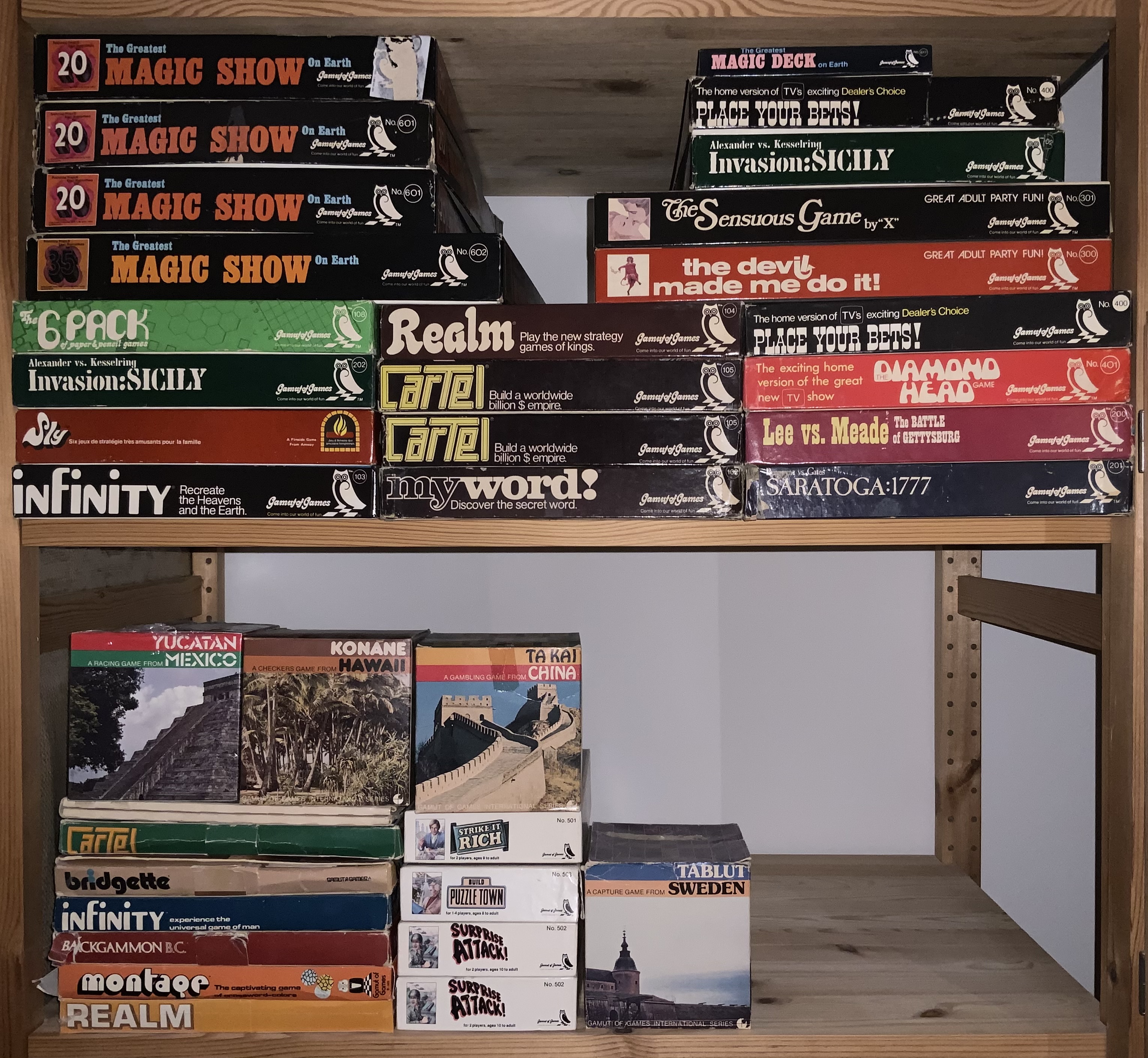
Joel Gaines initially distributed Bridgette through his Bridgette Game Co. In 1971, his expanded publishing company operated under the name Gamut of Games, Inc. Gaines, who later became known as Djoli Kansil, borrowed the name from Sackson’s book A Gamut of Games. Sackson himself worked with the publisher as a game designer and rules editor. Bridge expert Waldemar von Zedtwitz helped finance the company.
In 1972, Bridgette was joined by the word game My Word!. Phil Orbanes joined that same year. He started out helping with packaging, moved over to Gamut that fall, and later became the company’s president. By September, Bridgette had recouped its costs, according to Orbanes. A year later, the catalog included four new titles under the series name Great Family Fun. Gaines contributed his team word game Montage. Phil Orbanes brought his games Cartel, Realm, and Infinity into the lineup. Sackson tested variants and worked on the rules for Realm and Infinity. In Cartel, players built a conglomerate, while in Infinity they placed pieces in a galaxy much as you would place dominoes.
Among the new board games, Cartel initially sold best. Early in 1974, Orbanes reported that more than 15,000 copies had been shipped. A year later, he named Infinity as the boxed game that sold fastest in stores.
How Gamut Made Its Money
When backgammon came back into fashion in the early 1970s, Kansil responded to the trend with a set of his own. Gamut released it as Backgammon B.C. In July 1973, according to Orbanes, backgammon accounted for about 60 percent of Gamut’s business.
In November 1975, Orbanes identified the magic kits as the product line that was keeping Gamut going. Depending on the edition, The Greatest Magic Show on Earth contained props and instructions for 20, 35, or 55 magic tricks.
Reiss in Distribution, Rand in the Catalog
Reiss Associates represented Gamut in the trade while building its own line of games under the Hoi Polloi name. This made Gamut’s distribution partner a competitor as well. For that reason, Jed Gaines was already looking for other partners to market Bridgette and My Word! in 1972. A year later, the companies drew closer again. Reiss took over sales representation and billing, and Gamut of Games, Reiss Associates, and Hoi Polloi appeared side by side on the Realm box. Some designs intended for a planned continuation of Hoi Polloi’s paper-and-pencil series found a place in Gamut’s 6 Pack in 1974.
In the spring of 1974, Gamut and Reiss negotiated a takeover. According to Orbanes, von Zedtwitz was willing to sell until Reiss tried to lower the purchase price they had already agreed on. In June, von Zedtwitz decided to continue financing Gamut. The publisher remained independent and changed its sales representative (to Pager Industries, formerly Jerry Green and Pat Duncan’s Puzzle Factory). Reiss handled the International Series, whose games initially retained the Gamut label. The companies still had ties through their staff. Carl Eisenberg came from the Reiss and Hoi Polloi circle, took over sales at Gamut, and became vice president under Orbanes in 1975.
Rand Game Associates had a different business model. In 1974, Bill Vega offered a $17.76 annual subscription for nine planned conflict simulations. Gamut released three of them in its own boxes for retail sale as The Armchair General Series. These editions took players to Gettysburg, Saratoga, and the landing in Sicily. Meanwhile, Rand continued its Command Series. In 1975, the two publishers promoted their lines in a joint brochure. A shared printer was another link between Rand and Hoi Polloi.
At the end of December 1975, Bill Vega, the head of Rand, was still planning to move into an office in the same building as Gamut. On January 30, 1976, Jim Dunnigan was already reporting the split. According to him, Rand pulled out because Vega’s wife objected to Gamut’s adult games The Devil Made Me Do It! and The Sensuous Game by “X” (John B. Wexo was the designer of both games). On February 1, Phil Orbanes said that Gamut had ended the partnership because Vega had failed to keep his promises to supply plastic parts. What ultimately prompted the split remains unclear.
From a Broader Catalog to Closure
In 1974, Gamut opted for larger boxes and a broader range. Party games and magic kits soon appeared in the catalog alongside strategy games and classics. With The Diamond Head Game and Place Your Bets!, the publisher drew on two television shows in 1975. For Place Your Bets!, the home version of Dealer’s Choice, Gamut even negotiated eight seconds of advertising time per broadcast.
In December 1975, the financial backer lost interest. According to Orbanes, that was because Kansil had left and Bridgette was no longer the most important title. Orbanes and Eisenberg sought new investors, approaching E.S. Lowe among others. Gamut cut costs. In February 1976, Orbanes went to the toy manufacturer Ideal, while Eisenberg stayed on to handle sales.
Before that, Orbanes set one last series in motion, Great Little Games, in small oblong boxes. Build Puzzle Town was a tile-laying game in which a city is built from square districts. It was originally called Fun City. Strike It Rich, a dice game about mining claims, built on Pay Off from the 6 Pack. Surprise Attack!, a kind of chess with modern weapons, drew on ideas from Tablut. On April 9, 1976, the three games were ready. Orbanes liked the presentation, but he was annoyed that his name had been removed. Each game cost $5. Whether the series would continue was to depend on reorders.
1976 became a struggle for survival. There were difficulties in retail, and Gamut also tried selling by mail order. Eisenberg sounded out potential buyers, and Avalon Hill also held talks. He planned a new Bridgette box with an endorsement from Omar Sharif. A lawsuit Gamut won over outstanding payments brought in cash for a short time in November. In December, Orbanes nevertheless considered the publisher at risk again.
On January 5, 1977, Orbanes announced that Gamut would close at the end of the month. Eisenberg’s last working day was January 25. The remaining stock was to go to Bob Gellman, but Gellman did not want to take over the product line. Bob Reiss also declined. Gamut was still listed for Room 406 at the Toy Fair on February 22, 1977, though people there said the company had closed. Looking back, Orbanes spoke of a small profit under his and Eisenberg’s leadership. It had come nowhere near making up for the losses of the early years.
What Remained
The publisher disappeared, but its games did not vanish entirely. Orbanes regained the rights to Realm in November 1976, and a German edition later appeared with altered rules. The rights to the 6 Pack reverted to its authors in 1977. Cartel later reappeared under the name Dallas. In 1980, Kansil reported a forthcoming contract for My Word! with Ideal, where Eisenberg now wanted to use earlier Gamut titles.
From The Great Races to Can’t Stop
Sacksons Würfelspiel begann im Juli 1973 unter dem Arbeitstitel 11 Races. Vier Würfel werden in zwei Paare aufgeteilt. Ihre Summen bestimmen, auf welchen der elf Bahnen von 2 bis 12 man vorankommt. Wer etwa 1, 2, 4 und 5 würfelt, kann auf der 3 und der 9 vorziehen oder sich für die 5 und die 7 entscheiden. Im frühen Entwurf war ein Sieg auf der seltenen 2 oder 12 mehr wert als einer auf der häufigen 7. Gamut veröffentlichte das Spiel 1974 als The Great Races in seiner Papier-und-Bleistift-Sammlung. Die Zeitschrift GAMES griff es für ihre Ausgabe Januar/Februar 1978 unter dem Titel A Day at the Races erneut auf.
Sackson’s dice game began in July 1973 under the working title 11 Races. Four dice are split into two pairs. Their sums determine which of the eleven tracks, numbered 2 to 12, a player can advance on. A player who rolls 1, 2, 4, and 5, for example, can advance on tracks 3 and 9 or choose tracks 5 and 7. In the early design, winning on the rarely rolled 2 or 12 was worth more than winning on the often rolled 7. Gamut published the game in 1974 as The Great Races in its paper-and-pencil collection. The magazine GAMES featured it again in its January/February 1978 issue under the title A Day at the Races.
In March 1978, the French publisher Roland Borghini was looking for a quick dice game. During this period, Sackson developed Can’t Stop and initially tried using more dice and turn markers. After a few days, he was back to four dice and limited a turn to three active tracks. The same dice-pairing rule now served a new purpose. In The Great Races, finishing positions on the race tracks mattered. In Can’t Stop, after a successful roll, you decide whether to secure your progress or roll again. If the next roll gives you no legal move, all progress from that turn is lost. Whoever wins three tracks wins the game. Sackson himself later described The Great Races as a forerunner.
Sackson offered Can’t Stop to the French publisher. The publisher put the game on hold for the time being, but took on two other Sackson games.
Orbanes had since moved to Parker Brothers, where he came across the game again. He pushed for a molded plastic board with peg markers. Parker accepted the game in 1979 and brought it to market in 1980 with the octagonal stop sign as the game board (Borghini declined the French license). In December, Orbanes reported that about half a million copies had been sold to the trade.
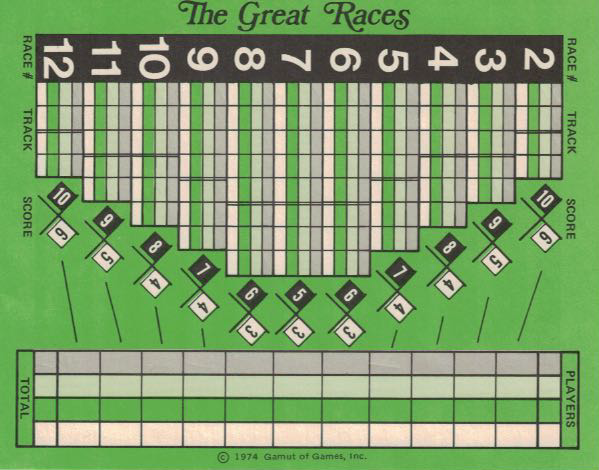
The Great Races is a dice race for two to four players by Sid Sackson. It was published in 1974 by Gamut of Games as part of The 6 Pack of Paper & Pencil Games. Sackson signed the contract on September 19 and received two copies on October 21.
- Four dice, eleven tracks. In the first draft, dated July 5, 1973, the game was called 11 Races. Players split four dice into two pairs and mark their progress on the tracks corresponding to the sums. Scoring covers all eleven sums from 2 to 12. In the draft, a win on 2 or 12 earned more points than a win on 7.
- Sackson shortened the tracks after a test game ran too long. The draft was briefly called Sprint. The almost identical title The Great Race, in the singular, was intended for a different game that was first called Laps and later Rally. Phil Orbanes wrote the first version of the rules for The Great Races. In July 1974, Sackson tested a change under which a track closed when the first player reached the finish. To take second place, a player had to have reached the marked final stretch by then.
- The magazine GAMES renamed it A Day at the Races. The proof also allowed players to split the dice 3+1. Sackson considered this crucial to how the game played and clarified with the editors that the change was based on a misunderstanding. Issue No. 3 for January/February 1978 contained the rules and an illustration. Sackson received it as early as November 30, 1977.
Sackson himself made the connection to Can't Stop. On September 2, 1980, he asked Walter Luc Haas to hold back the older game in his dealings with Hugendubel because it was “a forerunner of Can't Stop”.
Games by Series
- All Time Classics · Bridgette, Backgammon B.C.
- Great Family Fun, small square boxes · My Word!, Cartel, Infinity, Montage, Realm
- Great Family Fun, large oblong boxes · Cartel, Infinity, My Word!, Realm, The 6 Pack of Paper & Pencil Games. The 6 Pack contains Financier, Pay Off, Oil Strike!, Words Times Three, Spy, and The Great Races.
- The Armchair General Series · Lee vs. Meade: The Battle of Gettysburg, Burgoyne vs. Gates: Saratoga: 1777, Alexander vs. Kesselring: Invasion: Sicily
- Games for TV Fans · The Diamond Head Game, Place Your Bets!
- Great Adult Party Fun! · The Devil Made Me Do It!, The Sensuous Game by “X”
- International Series · Konane, Tablut, Ta Kai, Yucatan
- Magic product range · The Greatest Magic Show on Earth with 20, 35, or 55 tricks and The Greatest Magic Deck on Earth with 76 card tricks
- Great Little Games · Build Puzzle Town, Surprise Attack!, Strike It Rich
- Special edition for Amway · SLY 6 with Sniggle, Blockade, Empire, Get the Jump, Line Up, and Solitaire Sly